How can I help my teen with their Personal Statement?
How To Support Your Teen With Their Personal Statement So It Doesn't Sound Like Everyone Else's
What narrative psychology says about authentic voice — and how to help your teen find theirs.
Ask Dr. Emily Wassell
In Pride and Prejudice, Elizabeth Bennet spends the entire novel refusing to perform herself for anyone's approval — not Darcy's, not Lady Catherine's, not even her own mother's. It's the reason we still read the book two centuries later. It's also, I'd argue, the reason Darcy falls for her in the first place. He's surrounded by people parading themselves for his approval, and then he meets someone who simply... doesn't. The refusal to perform is the whole appeal.
I think about Elizabeth Bennet every August, because the personal statement is, structurally, a courtship document. And most teenagers approach it exactly backwards — performing a version of themselves they think the college wants to meet, instead of showing up as who they actually are and trusting that the right school will lean in.
College Admissions Is a Dating Problem, Not a Marketing Problem
Here's the reframe I give almost every family in August, because it changes everything downstream: applying to college is not advertising yourself to the highest bidder. It's a first date, conducted at scale, with a few hundred schools at once.
On a first date, the goal isn't to be the most impressive possible version of yourself. It's to be recognizably, specifically yourself — because the entire point of the date is to find out whether this is a match worth pursuing. A first date where you perform a fictional, flawless version of yourself doesn't get you a better match. It gets you a mismatch, six months in, once the performance becomes unsustainable.
The same logic applies with startling precision to college. A student who gets into a school by performing a version of themselves that doesn't actually exist hasn't won anything. They've set themselves up for a very expensive, very disorienting sophomore-year realization that the school fell for someone who isn't actually there.
The personal statement is the first date. Its job was never to impress. Its job is to let the right people recognize you — and let the wrong-fit places self-select out, which is just as valuable an outcome, even though nobody frames it that way.
Why "Just Be Yourself" Still Doesn't Work as Advice
I know — I spent an entire previous column arguing that "write about what makes you YOU" is close to useless advice, and now I'm telling you the goal is authenticity. Those aren't contradictory. The problem was never the goal of authenticity. The problem was treating it as something a teenager can simply retrieve on command.
Narrative identity research — particularly the work of Dan McAdams — tells us that authentic voice isn't a fact waiting to be reported. It's constructed through the specific, textured details a person chooses to notice and share. Authenticity, in other words, isn't a tone. It's a byproduct of specificity. The moment a student starts speaking in particulars instead of generalities, the "voice" problem tends to resolve itself, because generic language is what performance sounds like, and specific language is what a real, examined life sounds like.
Which brings me to the exercise I actually use.
The Exercise: Ten Things You Want the College to Know
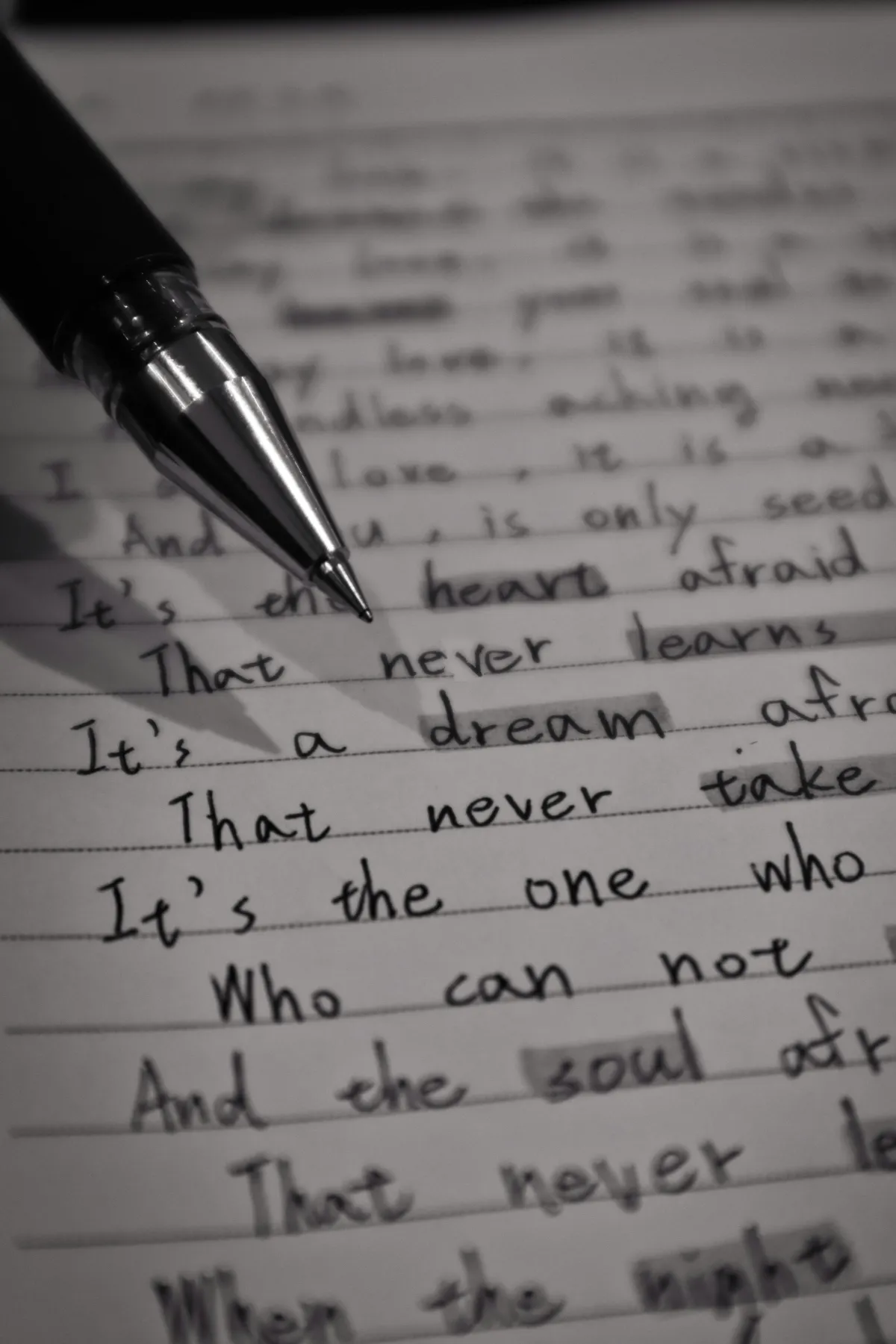
Before any student in my practice writes a word of an actual essay, I ask them to do something much smaller and much stranger: list ten things you want a college to know about you that wouldn't show up on your transcript.
Not ten achievements. Not ten extracurriculars. Ten true things — the kind of details you'd actually tell someone you were interested in getting to know, on a real first date, once you'd decided you liked them enough to be honest.
Here's what a real list often looks like, roughly a third of the way through, once a student stops performing for the exercise itself:
I've reorganized my closet by color at least six times and I don't know why it calms me down.
I've read the Percy Jackson series four times and I'm not embarrassed about it anymore.
I get genuinely upset when people don't return shopping carts.
I taught myself to solve a Rubik's Cube during a boring family reunion and now I can't stop doing it during tests.
I've never once finished a group project without silently doing the part someone else forgot.
None of these are "impressive" in the traditional admissions sense. All of them are true, specific, and instantly more interesting than "I am a hardworking and passionate student who loves to learn." That's not an accident. Specificity is functionally what authenticity sounds like on the page, and the ten-things list is a low-stakes way of generating raw material before the pressure of "this needs to be a great essay" contaminates the honesty of it.
Why this works, mechanically: the exercise deliberately routes around the evaluative anxiety that shuts down genuine reflection. Nobody feels performance pressure listing ten random true things. They feel it the moment they're asked to write "the essay." By the time a student has generated their list, they've usually already identified — without trying to — two or three details that reveal something real about how they think, what they value, or what makes them laugh. That's the actual raw material of a personal statement. The polished 650 words come later. The ten-things list is where the voice actually lives.
Strengths, Not Just Stories
Parents often assume the job here is to find "the story" — the dramatic turning point, the challenge overcome, the thing that sounds like a movie tagline. That instinct produces the mission-trip essay, the injury-comeback essay, the same handful of plots admissions readers see thousands of times a year.
What I ask parents to do instead is help their teen notice strengths, not plot points — and specifically, the kind of strengths that are easy for a person to overlook in themselves precisely because they've never had to work hard to have them.
Research on character strengths, notably the VIA classification developed by Christopher Peterson and Martin Seligman as part of the broader positive psychology movement, makes a useful distinction here: signature strengths are the ones a person uses so naturally they don't register as an accomplishment. The kid who is the one everyone calls when something needs fixing rarely thinks of reliability as a strength — it's just what they do. The kid who notices when someone's left out of a conversation rarely registers social attunement as a skill — it's just how they move through a room.
This is precisely why parents are so useful in this process, and precisely why it can't be outsourced entirely to a consultant, a coach, or an AI tool: you have twelve to eighteen years of raw observational data your teenager doesn't have access to about themselves. You remember the specific way they handled a friend's bad news at age nine. You remember what they built, unprompted, out of boredom, when they were eleven. You are sitting on an archive of evidence for exactly the kind of signature strengths research says people struggle to see in themselves — because we are, all of us, the worst observers of our own defaults.
A useful question to ask your teen this summer, instead of "what's your college essay about": Would you like to know what I see as your best qualities?" Then let them know a few specific adjectives that describe them, and the coresponding example story.
That question, more often than any writing prompt, is where I've watched real essays begin.
What This Looks Like in Practice
Once a student has their ten true things and has heard a parent reflect back a strength they hadn't noticed in themselves, the actual writing task gets dramatically smaller. They're no longer staring down "explain your entire identity in 650 words." They're expanding on one specific, already-true detail, already confirmed as genuinely theirs, already stripped of performance pressure because it emerged from a list, not a deadline.
This is, not incidentally, exactly how a good first date actually works. Nobody falls for a resume read aloud. People fall for the specific, small, unguarded detail — the closet reorganized by color, the shopping cart thing, the Rubik's Cube during exams — because those details are unmistakably, a particular person, and not a category of person.
The Elizabeth Bennet Principle
Elizabeth Bennet never once tries to be who Darcy wants her to be. She's sharp, occasionally wrong, unapologetically herself in rooms full of people who are performing for approval — and that refusal is precisely what makes the match, when it happens, real instead of manufactured.
That's the whole argument for the personal statement, distilled: the job was never to become the applicant a school wants. It's to be recognizably, specifically yourself, clearly enough that the right school can lean in — and the wrong one can, just as usefully, decide this isn't a match.
Help your teen find the ten true things. Tell them what strength you've always seen in them that they've never once thought to mention. The essay that comes after that is almost always the one that doesn't sound like everyone else's — because it isn't performing anyone else's life. It's just, finally, telling the truth about theirs.
If your teen has a blank document and a due date and nothing else, I'd love to help them find their ten things — and help you see the strengths you already know but haven't said out loud yet. I have a few spots open before senior year begins in earnest.
Sources referenced:
McAdams, D. P. — Narrative identity theory
Peterson, C., & Seligman, M. E. P. — VIA Classification of Character Strengths and Virtues
Positive psychology research on signature strengths and self-perception